How to Choose Silicon Carbide for Your First Purchase: A Beginner’s Guide
Choosing silicon carbide for the first time can be confusing. With different types, grit sizes, grades, and applications available, it is easy to order the wrong material if you are not familiar with the specifications.
Whether you need silicon carbide for abrasive blasting, grinding, polishing, lapping, refractory materials, ceramics, or precision applications, the right product depends mainly on the material type, particle size, application, and required performance.
This guide explains how to choose silicon carbide step by step, including the difference between Green Silicon Carbide and Black Silicon Carbide, how to select the right grit size, and what information you should provide when requesting a quotation.
1. What Is Silicon Carbide?
Silicon carbide (SiC) is a synthetic abrasive material known for its high hardness, sharp cutting ability, thermal stability, and chemical resistance.
Because of these properties, silicon carbide is widely used in applications such as:
- Abrasive blasting
- Grinding
- Polishing
- Lapping
- Surface preparation
- Refractory materials
- Ceramics
- Semiconductor processing
- Precision machining
For buyers who are new to silicon carbide, the first step is to understand that not all silicon carbide is the same.
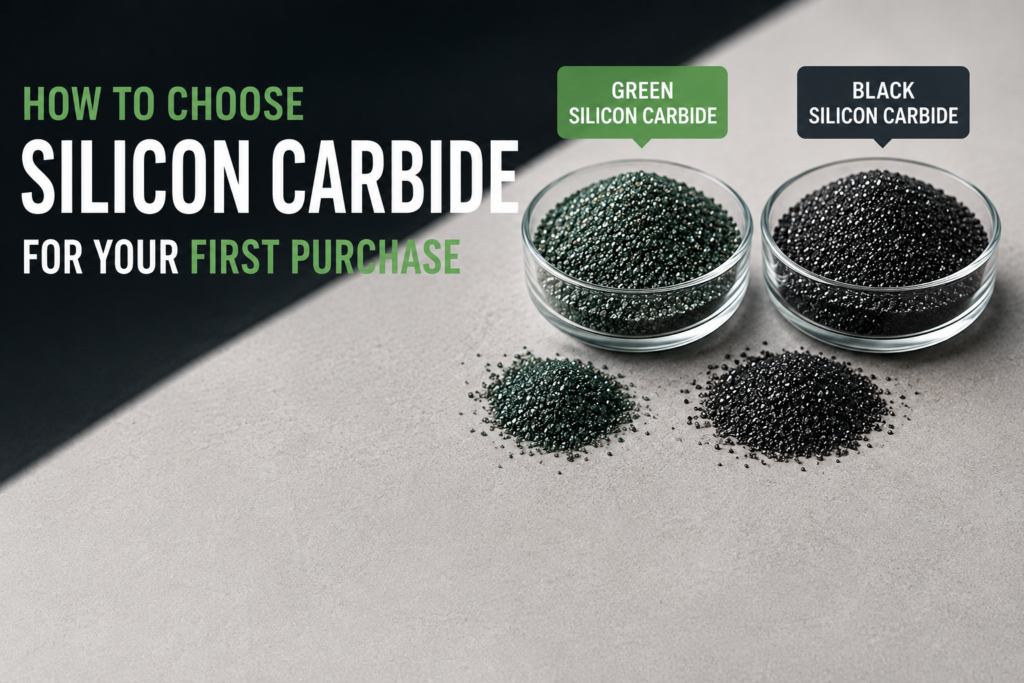
The two most common abrasive grades are:
2. Green Silicon Carbide vs. Black Silicon Carbide
One of the most common questions from first-time buyers is:
Should I choose Green Silicon Carbide or Black Silicon Carbide?
The answer depends mainly on your application.
Black Silicon Carbide
Black silicon carbide is widely used for general abrasive applications where high hardness and sharp cutting performance are required.
Typical applications include:
- Sandblasting
- Surface cleaning
- Paint and rust removal
- Grinding
- Cutting
- Abrasive tools
- Lapping
- Refractory applications
Black SiC is often a practical choice for general-purpose abrasive processing.
Green Silicon Carbide
Green silicon carbide generally offers higher purity and is commonly selected for applications requiring higher hardness, sharper cutting action, and more consistent abrasive performance.
Typical applications include:
- Precision grinding
- Fine polishing
- Lapping
- Optical glass processing
- Ceramics
- Semiconductor applications
- Precision components
Simple Comparison
| Feature | Black Silicon Carbide | Green Silicon Carbide |
|---|---|---|
| Typical purity | High | Higher |
| Hardness | Very high | Very high |
| Cutting ability | Excellent | Excellent |
| General abrasives | ✓ | ✓ |
| Sandblasting | ✓ | Possible |
| Grinding | ✓ | ✓ |
| Precision polishing | Possible | ✓ |
| Ceramics | ✓ | ✓ |
| Semiconductor applications | Limited | ✓ |
| Typical positioning | General abrasive use | Precision applications |
A simple rule for first-time buyers:
If you need a general-purpose abrasive for blasting, cleaning, grinding, or surface treatment, Black Silicon Carbide is often a good starting point. If your application requires higher purity or more precise finishing, Green Silicon Carbide may be more suitable.
3. How to Choose the Right Silicon Carbide Grit Size
After selecting the type of silicon carbide, the next important decision is particle size.
Grit size has a major influence on the final surface finish.
In general:
Coarser grit = faster material removal
Finer grit = smoother surface finish
For example, a coarse abrasive may be suitable for removing rust or coatings, while a fine abrasive may be better for polishing or precision finishing.
Coarse Grit
Coarse silicon carbide is commonly used for:
- Heavy material removal
- Surface preparation
- Rust removal
- Paint removal
- Aggressive blasting
- Initial grinding
Medium Grit
Medium grit can be suitable for:
- General grinding
- Surface preparation
- Deburring
- Moderate material removal
- Abrasive blasting
Fine Grit
Fine silicon carbide is commonly used for:
- Fine grinding
- Polishing
- Lapping
- Precision surface finishing
- Optical applications
4. Grit Size Is Not the Same as Application
A common mistake is to choose a grit size simply because another company uses it.
The correct grit size depends on several factors:
Material being processed
Hard materials may require a different abrasive specification than softer materials.
Desired surface finish
If you need aggressive material removal, a coarser grit may be appropriate.
If you need a smooth finish, a finer grit is usually preferred.
Equipment
Your blasting, grinding, or polishing equipment may have specific abrasive size requirements.
Processing speed
Coarser particles can generally remove material more aggressively, while finer particles are better suited to finishing.
Final surface requirements
The required roughness and appearance of the finished surface should also be considered.
Therefore, there is no single “best” silicon carbide grit size for every application.
5. Silicon Carbide Grit or Powder: Which One Should You Buy?
Another important consideration is whether you need silicon carbide grit or silicon carbide powder.
Silicon Carbide Grit
Grit generally refers to a defined range of relatively larger abrasive particles.
It is commonly used for:
- Sandblasting
- Grinding
- Surface preparation
- Abrasive tools
- Cutting applications
Silicon Carbide Powder
Fine silicon carbide powder is used when a much finer particle size is required.
Typical applications include:
- Precision polishing
- Lapping
- Fine grinding
- Ceramics
- Semiconductor-related applications
- Specialized surface finishing
If you are unsure whether your process requires grit or powder, provide your application, equipment, and desired surface finish to the supplier. An experienced supplier can usually help narrow down the appropriate specification.
6. How to Choose Silicon Carbide Based on Your Application
A simple way to select the right product is to start with the application instead of the product name.
| Application | Possible SiC Choice |
|---|---|
| Sandblasting | Black SiC |
| Rust removal | Black SiC |
| Surface cleaning | Black SiC |
| General grinding | Black or Green SiC |
| Deburring | Black or Green SiC |
| Fine grinding | Green SiC |
| Precision polishing | Green SiC |
| Lapping | Green SiC |
| Optical glass processing | Green SiC |
| Ceramic processing | Green or Black SiC |
| Semiconductor applications | Green SiC |
These recommendations are only a starting point. The actual specification should be selected according to your equipment, material, processing method, and required finish.
7. What Should You Tell a Silicon Carbide Supplier?
When requesting a quotation for the first time, simply saying:
“I need silicon carbide.”
is usually not enough.
To receive an accurate quotation, try to provide the following information.
Product Type
For example:
- Black Silicon Carbide
- Green Silicon Carbide
Particle Size
For example:
- #16
- #24
- #36
- #46
- #60
- #80
- #120
- #180
- #220
- Fine powder
Application
Explain how you will use the material.
For example:
“We need Black Silicon Carbide for abrasive blasting.”
or:
“We need Green Silicon Carbide for precision polishing.”
Quantity
Tell the supplier your estimated purchase volume, such as:
- 25 kg
- 100 kg
- 500 kg
- 1 ton
- 20 tons
Packaging Requirements
Depending on your logistics requirements, you may need:
- Bags
- PP bags
- Paper bags
- Pallets
- Customized packaging
Quality Requirements
If your application has specific technical requirements, mention them in advance, such as:
- SiC content
- Chemical composition
- Particle size distribution
- Magnetic content
- Moisture
- Packaging
- Certificate of Analysis (COA)
8. A Simple Example for First-Time Buyers
Imagine you operate a metal surface treatment company and want to remove rust and old coatings.
You could start by describing your requirement like this:
Product: Black Silicon Carbide
Application: Abrasive blasting
Grit: Medium/coarse grit
Quantity: 1 ton
Packaging: 25 kg bags
Destination: Your country/port
This gives the supplier enough information to recommend a suitable specification and provide a more accurate quotation.
On the other hand, if you are processing optical glass and need a smooth surface finish, you may need:
Product: Green Silicon Carbide
Application: Precision grinding/polishing
Particle size: Fine grit or powder
Quantity: Based on trial requirements
The important point is that the application should determine the product specification—not the other way around.
9. Common Mistakes When Buying Silicon Carbide for the First Time
Mistake 1: Choosing only by price
The cheapest silicon carbide is not necessarily the most economical option.
Particle size consistency, purity, hardness, and abrasive performance can affect your actual processing cost.
Mistake 2: Choosing the wrong grit size
A grit that is too coarse may create a rougher surface than expected.
A grit that is too fine may reduce material removal efficiency.
Mistake 3: Choosing Green SiC simply because it is “better”
Green silicon carbide is not automatically better for every application.
If you are performing general blasting or surface cleaning, Black SiC may already meet your requirements.
Mistake 4: Not specifying the application
Without knowing your application, it is difficult for a supplier to recommend the correct product.
Mistake 5: Buying a large quantity before testing
For a new application, it can be useful to conduct a small trial first.
Test the abrasive under your actual processing conditions before placing a large-volume order.
10. A Practical Silicon Carbide Selection Checklist
Before placing your first order, check these points:
☐ Black or Green Silicon Carbide
☐ Grit or Powder
☐ Required grit size
☐ Application
☐ Material being processed
☐ Desired surface finish
☐ Required quantity
☐ Packaging
☐ Chemical/quality requirements
☐ Sample or trial requirement
If you can provide these details, the purchasing process becomes much easier and the risk of ordering an unsuitable abrasive is significantly reduced.
Conclusion
Choosing silicon carbide for the first time does not have to be complicated.
Start with your application, then determine whether you need Black Silicon Carbide or Green Silicon Carbide. After that, select the appropriate grit size or powder specification according to your material, equipment, material-removal requirements, and desired surface finish.
For general abrasive applications such as blasting, cleaning, and rust removal, Black Silicon Carbide is often a practical choice. For precision grinding, polishing, lapping, and applications requiring higher purity, Green Silicon Carbide may be more appropriate.
Most importantly, don’t select silicon carbide based on grit size or price alone. The right abrasive is the one that matches your specific processing requirements.
If you are still unsure which grade or grit size to choose, provide your application, material, equipment, desired finish, and quantity to your silicon carbide supplier. This information will make it much easier to identify the right specification for your project.