Silicon Carbide Powder: Properties, Types, Particle Sizes and Applications
Introduction
Silicon carbide powder is a high-performance industrial material widely used in grinding, lapping, polishing, surface finishing, refractory production, and other precision processing applications. Known for its high hardness, sharp cutting ability, wear resistance, and excellent thermal and chemical stability, silicon carbide is one of the most widely used synthetic abrasive materials.
Compared with coarse silicon carbide grit, silicon carbide powder consists of finer particles and is commonly selected for applications that require greater precision and smoother surface finishes. By choosing the right particle size, purity, and type of silicon carbide, manufacturers can achieve better processing efficiency and more consistent results.
Silicon carbide powder is mainly available in two common types: green silicon carbide powder and black silicon carbide powder. While both materials offer excellent abrasive performance, their properties and recommended applications can differ.
This guide explains the key properties, types, particle sizes, and major applications of silicon carbide powder, helping you choose the right material for your processing requirements.
What Is Silicon Carbide Powder?
Silicon carbide powder is a finely processed form of silicon carbide (SiC), a hard and chemically stable compound made from silicon and carbon. After production and crushing, silicon carbide is processed into different particle size ranges through grading and classification.
Depending on the required application, silicon carbide powder can range from relatively coarse fine-grit materials to ultra-fine micropowders used for precision lapping and polishing.
Because of its excellent hardness and sharp crystal structure, silicon carbide powder can effectively remove material from hard and brittle surfaces. It is commonly used for processing materials such as:
- Optical glass
- Ceramics
- Stone
- Hard alloys
- Non-ferrous metals
- Silicon wafers
- Precision components
The correct silicon carbide powder depends on several factors, including particle size, material purity, crystal type, and the required surface finish.
Key Properties of Silicon Carbide Powder
Silicon carbide powder offers a combination of physical and chemical properties that make it suitable for demanding industrial applications.
| Property | Typical Characteristic |
|---|---|
| Chemical Formula | SiC |
| Hardness | Approximately 9–9.5 on the Mohs scale |
| Crystal Structure | Hard and sharp-edged |
| Wear Resistance | Excellent |
| Thermal Stability | Excellent |
| Chemical Stability | Good |
| Thermal Conductivity | High |
| Abrasive Performance | High cutting efficiency |
High Hardness
Silicon carbide is significantly harder than many conventional abrasive materials. Its high hardness allows it to effectively process hard, brittle, and wear-resistant materials.
Sharp Cutting Ability
The particles of silicon carbide have sharp edges that can provide efficient cutting action during grinding and polishing. This helps improve material removal performance.
Excellent Wear Resistance
Silicon carbide maintains its abrasive performance during demanding processing operations, making it suitable for applications that require consistent cutting and long-lasting abrasive performance.
Good Thermal Stability
Silicon carbide can perform in high-temperature environments and is therefore also used in refractory and high-temperature industrial applications.
Types of Silicon Carbide Powder
The two most common industrial types are green silicon carbide powder and black silicon carbide powder.
Green Silicon Carbide Powder
Green silicon carbide powder generally has higher purity and is known for its high hardness, sharp cutting edges, and excellent abrasive performance.
It is commonly used for processing hard and brittle materials that require high precision and a controlled surface finish.
Typical applications include:
- Optical glass processing
- Precision lapping
- Ceramic grinding
- Hard alloy processing
- Precision polishing
- Semiconductor and electronic materials
- Fine surface finishing
Green silicon carbide powder is often selected when higher purity and stronger cutting performance are required.
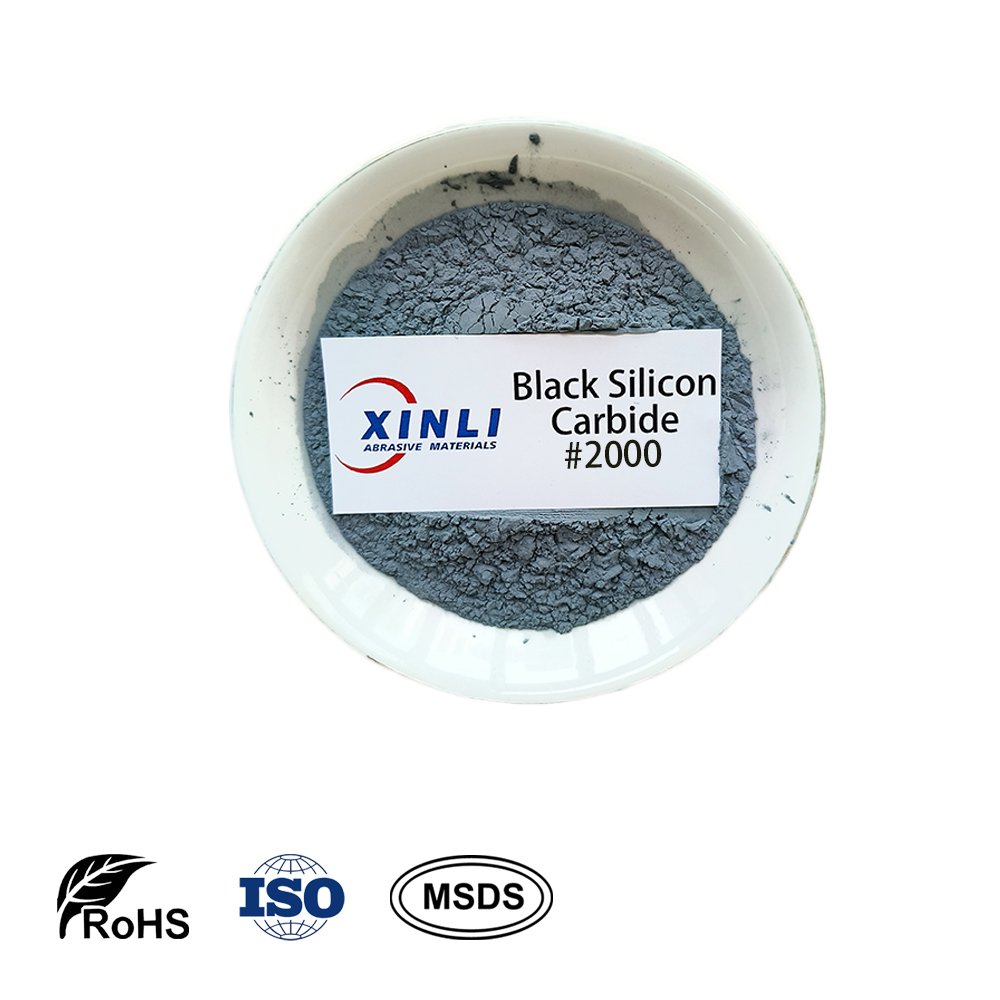
Black Silicon Carbide Powder
Black silicon carbide powder is a widely used industrial abrasive known for its good hardness, toughness, and cost-effectiveness.
It is suitable for a broad range of general grinding, surface treatment, and abrasive processing applications.
Typical applications include:
- Metal grinding
- Surface preparation
- Stone processing
- General polishing
- Abrasive products
- Refractory materials
- Industrial surface finishing
The right choice between green and black silicon carbide powder depends on the material being processed, the required finish, and the specific performance requirements of the application.
Silicon Carbide Powder Particle Sizes
Particle size is one of the most important factors when selecting silicon carbide powder.
In general:
Larger particles provide faster material removal, while smaller particles help produce smoother and more precise surface finishes.
Silicon carbide powder is available in a wide range of particle sizes, depending on the grading standard and application requirements.
| Particle Size Range | Typical Application |
|---|---|
| F240–F320 | Fine grinding and surface preparation |
| F360–F500 | Fine finishing |
| F600–F800 | Precision lapping |
| F1000–F1200 | Fine polishing |
| F1500 and finer | Precision polishing and ultra-fine finishing |
For highly specialized applications, silicon carbide micropowder can also be produced in much finer particle size ranges.
When selecting a powder size, it is important to consider:
- Workpiece material
- Required material removal rate
- Surface roughness requirements
- Processing method
- Desired final finish
For information about larger and coarser abrasive particles, you can also read our guide: Silicon Carbide Grit Sizes: A Complete Guide to Choosing the Right Mesh Size.
Silicon Carbide Powder Applications
Thanks to its hardness, sharp cutting ability, and wide range of particle sizes, silicon carbide powder is used across many industries.
Precision Lapping
Silicon carbide powder is commonly used in lapping processes where a controlled amount of material must be removed to achieve a smooth and accurate surface.
Fine and ultra-fine silicon carbide powders can be used for processing:
- Precision metal components
- Ceramic parts
- Glass components
- Hard and brittle materials
Particle size selection is especially important in lapping because it directly affects both the material removal rate and the final surface quality.
Optical Glass Processing
Silicon carbide powder is widely used for grinding and processing optical glass and other glass materials.
Its sharp abrasive particles help efficiently remove material during the earlier stages of glass processing. Finer particle sizes can then be used when a smoother surface is required.
Common applications include:
- Optical glass
- Lens blanks
- Technical glass
- Specialty glass components
Ceramic Grinding and Polishing
Technical ceramics are often hard and brittle, requiring an abrasive with strong cutting ability.
Silicon carbide powder can be used for:
- Ceramic grinding
- Surface finishing
- Edge processing
- Precision polishing
The appropriate particle size should be selected based on the ceramic material and the required surface finish.
Metal Surface Finishing
Silicon carbide powder is also used for processing a variety of metal materials.
Depending on the grit or powder size, it can be used for:
- Fine grinding
- Surface preparation
- Deburring
- Surface finishing
- Pre-polishing
For applications involving very hard materials, the required abrasive type and particle size should be carefully matched to the workpiece.
Semiconductor and Electronic Materials
Fine and high-purity silicon carbide powder can be used in precision processing applications involving hard and brittle electronic materials.
These applications may require strict control of:
- Particle size distribution
- Purity
- Particle shape
- Consistency between production batches
For high-precision applications, a consistent and stable powder specification is often just as important as the average particle size.
Refractory and High-Temperature Materials
Silicon carbide is also used as a raw material in refractory and high-temperature products because of its thermal stability and resistance to wear.
Depending on the formulation, silicon carbide powder can be incorporated into materials used in:
- High-temperature linings
- Kiln furniture
- Industrial furnaces
- Wear-resistant refractory products
How to Choose the Right Silicon Carbide Powder
Choosing the right silicon carbide powder involves more than simply selecting the finest or hardest material.
1. Choose the Right Particle Size
The particle size should match the required processing stage.
For example:
- Coarser particles are generally used for faster material removal.
- Medium particle sizes are suitable for fine grinding and surface finishing.
- Fine and ultra-fine powders are used for precision lapping and polishing.
2. Select Green or Black Silicon Carbide
Green silicon carbide powder is generally selected for applications requiring higher purity, high hardness, and sharp cutting performance.
Black silicon carbide powder is commonly chosen for general industrial processing where good abrasive performance and cost efficiency are important.
3. Consider the Material Being Processed
Different workpiece materials may require different abrasive characteristics.
Important factors include:
- Material hardness
- Material brittleness
- Heat sensitivity
- Required surface quality
4. Define the Required Surface Finish
A rough grinding process and a precision polishing process require very different particle sizes.
Using multiple particle size stages can help gradually improve the surface finish while maintaining efficient processing.
5. Check Particle Size Consistency
For precision applications, consistency is essential.
A controlled particle size distribution can help achieve more stable processing performance and reduce variations in the final product.
Green vs. Black Silicon Carbide Powder: Which One Should You Choose?
There is no single answer for every application.
Choose green silicon carbide powder when your application requires:
- Higher purity
- Strong cutting performance
- Precision processing
- Fine grinding and polishing
- Processing of hard and brittle materials
Choose black silicon carbide powder when you need:
- Good abrasive performance
- General industrial grinding
- Surface treatment
- Good toughness
- Cost-effective processing
In many cases, the best choice depends on both the abrasive material and the specific particle size.
Why Particle Size Distribution Matters
The average particle size alone does not always provide a complete picture of powder performance.
For demanding applications, the particle size distribution can affect:
- Cutting efficiency
- Surface finish
- Processing consistency
- Scratch depth
- Material removal rate
A powder with a well-controlled particle size distribution can provide more predictable processing results.
This is particularly important in applications such as:
- Precision lapping
- Optical glass processing
- Fine polishing
- Semiconductor material processing
When purchasing silicon carbide powder for a specialized application, it is important to confirm the particle size specification and testing standard with the supplier.
Frequently Asked Questions About Silicon Carbide Powder
What is silicon carbide powder used for?
Silicon carbide powder is used for grinding, lapping, polishing, surface finishing, optical glass processing, ceramic processing, metal finishing, abrasive products, and refractory materials.
Is silicon carbide powder harder than aluminum oxide?
Silicon carbide is generally harder and sharper than conventional aluminum oxide abrasives. It is often preferred for processing hard and brittle materials that require strong cutting performance.
What is the difference between silicon carbide grit and silicon carbide powder?
Silicon carbide grit usually refers to relatively coarser abrasive particles, while silicon carbide powder generally refers to finer particle sizes used for fine grinding, lapping, polishing, and precision processing.
Which is better, green or black silicon carbide powder?
Neither is universally better. Green silicon carbide is commonly selected for higher-purity and precision applications, while black silicon carbide is widely used for general industrial grinding and cost-effective abrasive processing.
How do I choose the right silicon carbide powder size?
Consider the material being processed, the required material removal rate, the processing method, and the desired final surface finish. Coarser particles generally remove material faster, while finer powders help produce smoother surfaces.
Conclusion
Silicon carbide powder is a versatile abrasive material available in a wide range of types and particle sizes. Its high hardness, sharp cutting ability, wear resistance, and thermal stability make it suitable for applications ranging from general grinding to high-precision lapping and polishing.
When choosing silicon carbide powder, the most important factors include particle size, particle size distribution, material purity, abrasive type, and the specific application requirements.
Green silicon carbide powder is commonly used for high-purity and precision applications, while black silicon carbide powder offers reliable performance for a wide range of general industrial uses.
By selecting the right silicon carbide type and particle size, manufacturers can improve processing efficiency, achieve better surface finishes, and maintain more consistent production results.
Looking for silicon carbide powder for your application? Contact us to discuss your required particle size, material type, and technical specifications.