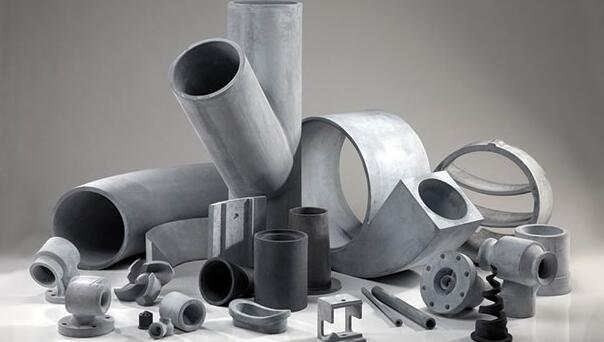
Silicon carbide is an important abrasive and functional material in the ceramics industry, where high hardness, wear resistance, thermal stability, and precise surface finishing are essential. Both green silicon carbide and black silicon carbide are widely used in the processing of ceramic materials for grinding, shaping, lapping, polishing, and surface preparation. Green silicon carbide, with its high purity and sharp crystal structure, is particularly suitable for precision grinding and finishing of advanced ceramics such as alumina ceramics, zirconia ceramics, silicon nitride, silicon carbide ceramics, and other technical ceramics. Black silicon carbide is commonly used for general-purpose grinding, shaping, and surface preparation of ceramic products due to its excellent hardness, cutting efficiency, and cost-effectiveness.
Silicon carbide has excellent hardness, sharp cutting edges, high thermal conductivity, and strong chemical stability, making it highly effective for processing hard and brittle ceramic materials. Green silicon carbide is preferred for precision grinding, lapping, and finishing because of its high purity and sharp abrasive grains, which provide efficient material removal and excellent surface quality. Black silicon carbide is widely used for rough grinding, shaping, and general surface preparation. The excellent cutting performance of silicon carbide helps improve processing efficiency while maintaining dimensional accuracy and reducing surface defects.
Silicon carbide abrasives are widely used for processing a variety of advanced and technical ceramics, including alumina (Al₂O₃), zirconia (ZrO₂), silicon nitride (Si₃N₄), silicon carbide (SiC), mullite, and other high-performance ceramic materials. Coarser grit sizes are commonly used for initial grinding, shaping, and material removal, while finer grit sizes and silicon carbide micro powders are used for precision lapping, polishing, and surface finishing. The selection of green or black silicon carbide depends on the ceramic material, processing method, required surface finish, and precision requirements.
For ceramic manufacturing and processing, silicon carbide is typically supplied in various grit sizes and micro powders to meet different grinding, lapping, and polishing requirements. Green silicon carbide is commonly used for precision grinding and fine finishing of advanced ceramics, ceramic components, ceramic wafers, and other high-performance materials where high purity and excellent surface quality are required. Black silicon carbide is widely used for rough grinding, shaping, and general-purpose processing of ceramic products. Its outstanding hardness, sharp cutting ability, and thermal stability contribute to high material removal efficiency, stable processing performance, and improved surface quality. Silicon carbide abrasives are extensively used in the production and finishing of alumina ceramics, zirconia ceramics, silicon nitride ceramics, silicon carbide ceramics, electronic ceramics, structural ceramics, and other advanced ceramic components.
Silicon carbide abrasives provide high grinding efficiency, excellent cutting performance, and reliable surface finishing for ceramic materials. Their high hardness and sharp abrasive grains enable efficient processing of hard and brittle ceramics, while their excellent thermal and chemical stability support consistent performance during high-speed and continuous grinding. Green silicon carbide is particularly suitable for precision grinding, lapping, and fine finishing, while black silicon carbide provides a cost-effective solution for rough grinding, shaping, and general ceramic processing. These advantages help ceramic manufacturers achieve improved dimensional accuracy, reduced surface defects, higher processing efficiency, and consistent product quality.